Marketing in 2026 has a hard truth most teams are still avoiding. You are not competing on creativity anymore. You are competing on how fast and how accurately you can make decisions.
And right now, most companies are losing that game.
Data is everywhere but it does not connect. Campaigns run, tools multiply, dashboards look impressive, yet the customer experience still feels broken. This is the Data Overhaul crisis. More data has not made marketing smarter. It has made it fragmented.
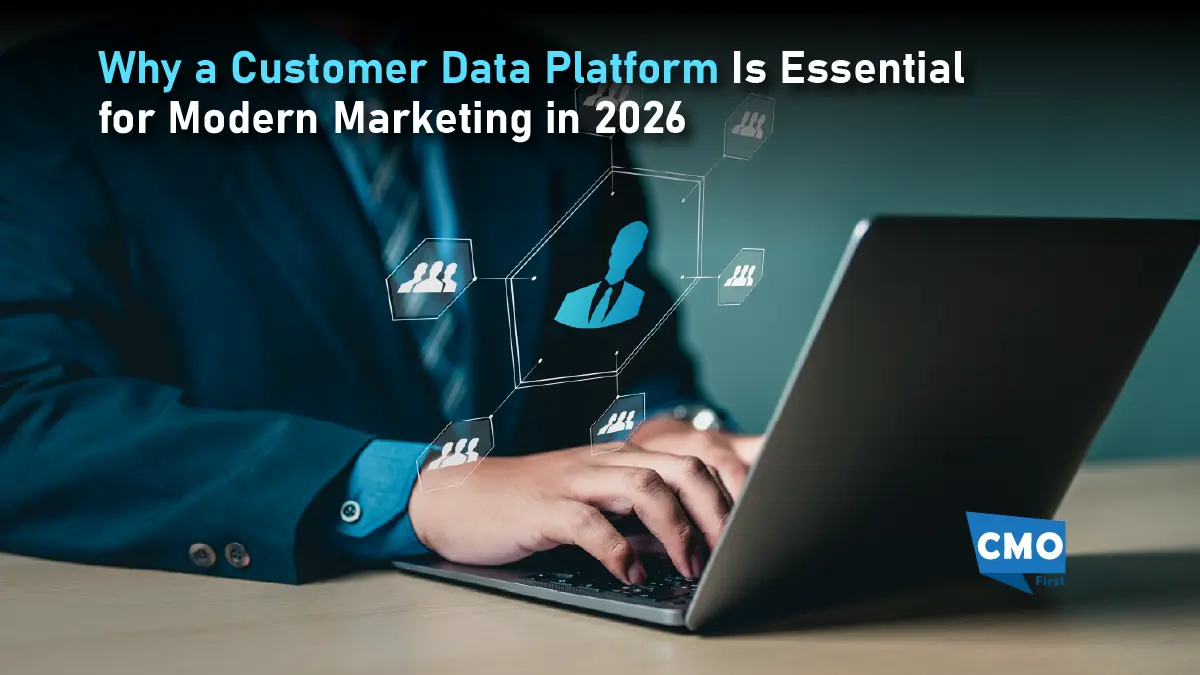
This is exactly where a customer data platform steps in. Not as another tool, but as the context engine that makes AI work. Because without unified, real-time, governed data, your AI is not intelligent. It is guessing.
Even Google is moving in this direction. It is introducing agentic capabilities for marketers, and over half a million advertisers are already using conversational AI in Google Ads to improve campaign quality.
So this article breaks it down clearly. Why the customer data platform has become essential, how it powers agentic marketing, and what it actually delivers in terms of business impact.
The Core Pillars of a 2026 CDP
Let’s cut through the noise. A modern customer data platform is not defined by dashboards or segments. It is defined by three things that actually work in the real world.
First is unified customer profiles. Not the old 360-degree view that looks good in presentations. What matters now is persistent identity resolution. The ability to recognize the same user across devices, sessions, and channels without breaking context. Because if identity breaks, everything built on top of it fails.
Second is real-time data ingestion. Batch processing is too slow for a world where decisions happen in milliseconds. If your system updates every few hours, your personalization is already outdated. Modern CDPs operate at sub-second speeds so actions can happen when intent is still alive.
Third is privacy-first governance. This is not about compliance checklists anymore. It is about making consent usable at the attribute level. Who can use what data, when, and for which purpose. If this is not automated, your entire AI layer becomes a liability.
This is exactly where the architecture shift comes in. Amazon Web Services has developed a future vision which combines all data storage systems and AI technologies into one unified data environment. The goal is simple. The team needs to eliminate organizational barriers which will help them achieve their insights while keeping their operations under control.
Put all three together and you get something powerful. Not just data storage, but a system that actually understands customers in real time.
Also Read: Customer Data Platforms in 2026: How CDPs Power Unified Customer Intelligence for Modern Marketing
Why 2026 Belongs to the Agentic CDP
We need to stop thinking about CDPs the old way.
First came Data CDPs. They collected and organized data. Useful, but passive.
Then came Campaign CDPs. They activated data across channels. Better, but still dependent on human triggers.
Now we are entering the phase of Agentic CDPs. This is where things get interesting.
In this model, the customer data platform does not just store or activate data. It powers decisions. Automatically.
Here is the problem most people miss. AI does not fail because it is not smart enough. It fails because it lacks context. Large language models can generate responses, but they cannot understand your customer unless you feed them structured, real-time, first-party data.
That is the role of a CDP.
Imagine this. A user browses a product but does not buy. Instead of waiting for a marketer to act, the system detects intent instantly. It adjusts ad bids, triggers a personalized WhatsApp message, and suppresses irrelevant emails. All of this happens without manual intervention.
This is not futuristic. It is already starting.
Microsoft reports that 46 percent of leaders are already using agents to automate workflows. 43 percent are working with multi-agent systems. And 82 percent expect to adopt an agentic workforce within the next 12 to 18 months.
Read that again. This is not experimentation. This is transition.
So when people ask whether they need a customer data platform, they are asking the wrong question. The real question is whether their AI has the context required to act correctly.
Because without that, automation just scales bad decisions faster.
Quantifiable Benefits That Go Beyond Personalization

Let’s get practical. This is where most articles stay vague. We won’t.
Yes, a customer data platform improves personalization. But that is just the surface.
The real value shows up in three areas.
First is hyper-personalization at scale. Not one channel, not one journey. We are talking about delivering consistent, 1:1 experiences across 10 to 15 touchpoints simultaneously. Website, ads, email, app, messaging. All aligned because they are powered by the same data layer.
Second is operational efficiency. Most marketing teams do not realize how much time they waste moving data around. Exports, imports, reconciliation. It adds up quickly. When a CDP removes data silos, teams recover hours every week that can be used for strategy instead of plumbing.
Third is revenue impact. And this is where things become hard to ignore.
According to McKinsey & Company, personalization can reduce customer acquisition costs by up to 50 percent. It can increase revenue by 5 to 15 percent. And it can improve marketing ROI by 10 to 30 percent.
Now connect that back to execution.
If your system can suppress converted users in real time, you reduce wasted ad spend. If it can identify high-intent users faster, you improve conversion rates. If it can unify signals across channels, you stop sending irrelevant messages.
This is not about better marketing. It is about eliminating inefficiencies that quietly drain growth.
Choosing the Right CDP in 2026
Now comes the tricky part. Not all customer data platforms are built the same.
The first decision is architecture. Warehouse-native or composable. Do you build on top of your existing data stack or bring in a separate system? There is no universal answer. It depends on how mature your data infrastructure already is.
The second is zero-copy integration. This is where things are shifting fast. Instead of moving data between systems, modern CDPs access it where it already exists. This reduces duplication, latency, and risk.
Salesforce is pushing this approach with its zero-copy architecture, allowing teams to act on data without physically moving it. More importantly, it shows real business impact. FedEx reported a 2000 percent ROI using Data 360.
That is not a small improvement. That is a transformation.
The third is time to value. Earlier, CDP implementations took months. Now the expectation is speed. Faster deployment, quicker integrations, and early wins. Because if a system takes too long to prove value, teams lose trust.
So the right question is not which CDP is best. It is which one fits your ecosystem, your speed, and your ability to execute.
Implementation Pitfalls You Cannot Ignore
Let’s be honest. Most CDP failures are not because of the tool. They happen because of execution.
The first trap is dirty data. If your underlying data is incomplete, inconsistent, or outdated, your AI will make wrong decisions. And it will do it confidently. That is dangerous.
The second is over-complicating the stack. More tools do not mean better outcomes. In fact, they often create confusion, duplication, and fatigue. Simplicity wins here.
The third is lack of alignment. A customer data platform cannot sit inside marketing alone. Sales, service, and product teams all need to contribute and consume the same data. Otherwise, you are just creating another silo with a better UI.
So before you implement anything, fix the foundation. Clean data, clear ownership, and shared goals.
Future-Proofing Your Marketing

Here is the reality most teams are not ready to accept.
By 2027, companies without a customer data platform will not just fall behind. They will become AI-blind. Their systems will act without context, and their decisions will drift further away from reality.
This is not about adopting another tool. It is about building the foundation for how decisions are made in your organization.
So start simple. Audit your data. Understand where it lives, how it flows, and where it breaks.
Then choose a system that fits your reality, not someone else’s roadmap.
Because in this new world, the winners will not be the ones with the most data.
They will be the ones who can actually use it.