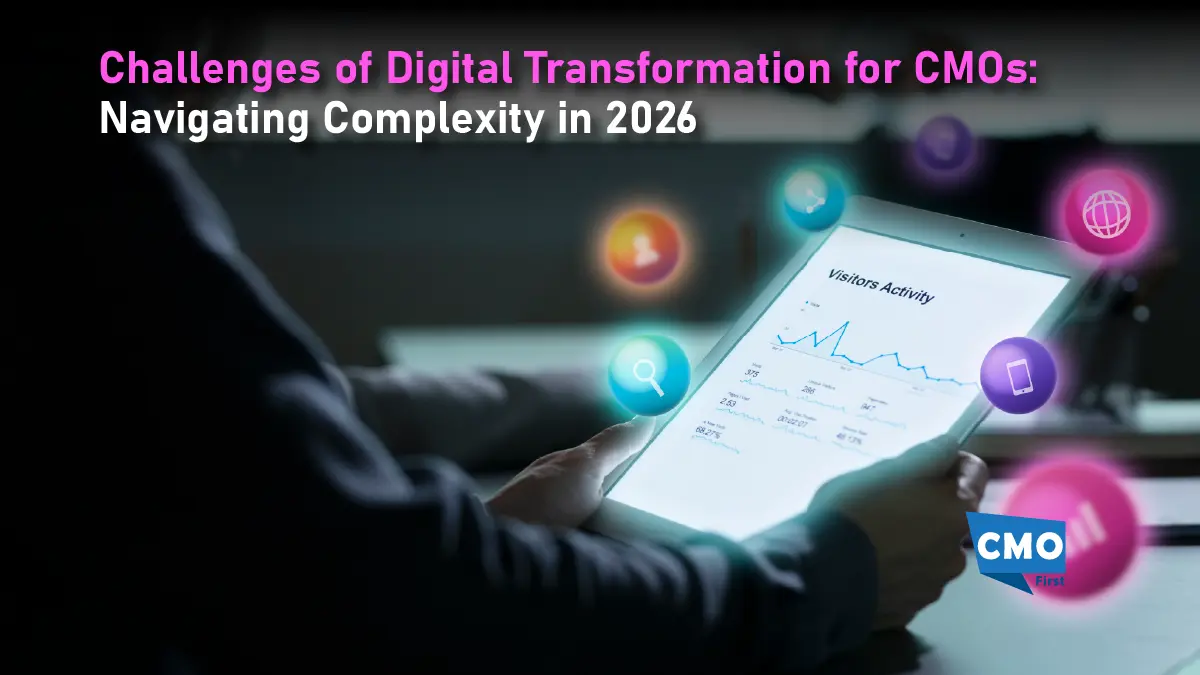
Chief marketing officers now handle more than just building public perception about their brands. The CMO role has transformed into operational and technical work which requires more public exposure than before. The brand architect must now function as an algorithm orchestrator whether they want to accept this new role or not.
Digital transformation is not a roadmap anymore. It is the environment. It is how marketing runs, how decisions are made, and how customers interact with brands. Yet most organizations are still carrying baggage from the early 2020s. Legacy systems, fragmented data, and outdated thinking are still in play.
That is where the real tension sits. The challenges of digital transformation for CMOs are no longer about adoption. They are about alignment. Between systems, teams, and expectations. And more importantly, about preparing for an agentic reality where machines, not humans, increasingly decide what gets seen, trusted, and bought.
The Agentic Consumer and the Death of Traditional Search

Search is not dying. It is mutating. And CMOs are still optimizing for a version of search that no longer exists.
For years, marketing operated on a simple logic. A user searches, evaluates options, clicks, and converts. That journey is now being quietly dismantled. The shift is not gradual either. It is structural.
Google says it sees over 5 trillion searches annually. That number sounds reassuring until you look deeper. Its 2026 guidance makes something very clear. The era of disconnected tests is over. More importantly, AI assistants are now shopping on behalf of users. Trust, not visibility, is becoming the deciding factor.
Also Read: Why a Customer Data Platform Is Essential for Modern Marketing in 2026
This changes everything.
The customer is no longer the only decision-maker. AI systems are filtering, comparing, and recommending before a brand even enters the conversation. Discovery is no longer a human-first experience. It is mediated.
So the question shifts. It is no longer about ranking higher. It is about being chosen by systems that do not think like humans.
Most brands are not ready for that. They still optimize for clicks, impressions, and funnels. However, agentic systems do not care about any of that. They care about structured data, credibility signals, and consistency.
That is where the first major challenge of digital transformation for CMOs begins. Marketing is moving from persuasion to qualification. If your brand is not machine-readable, machine-trusted, and machine-recommended, it simply does not exist in the new discovery layer.
The Data Chasm from Silos to Data Fabrics

Every CMO talks about personalization. Very few can actually deliver it.
The reason is not a lack of intent. It is a lack of integration.
Legacy data silos have transformed from internal company problems into customer experience problems. The presence of data in separate CRM systems and social media platforms and commerce systems and IoT devices creates a straightforward outcome. The result produces broken customer journeys.
Salesforce captures this gap clearly. 83% of customers expect two-way engagement. Yet 69% of marketers struggle to respond in real time because they lack the context. Even more telling, only 58% have full access to service data, 56% to sales data, and 51% to commerce data.
That is not a tech gap. That is fragmentation at scale.
So while customers expect seamless interactions, organizations are still stitching together partial views. The outcome is predictable. Irrelevant messaging, delayed responses, and lost trust.
This is why the conversation is shifting toward data fabrics and composable architectures. Not as buzzwords, but as survival mechanisms. CMOs can no longer operate in isolation. The partnership with CIOs is no longer optional. It is foundational.
Because in 2026, the challenge is not collecting data. It is making sense of it in real time. Without that, personalization remains a promise that marketing teams cannot keep.
Modernizing Legacy Mentalities and Systems
Technology gets blamed. Culture quietly escapes accountability.
Most organizations assume that digital transformation fails because of outdated systems. That is only half the truth. The bigger issue is outdated thinking.
There is still a tendency to treat transformation as a project. Something with a start date, a budget, and a finish line. That model is already obsolete. Transformation is continuous. It is iterative. It demands constant adjustment.
McKinsey & Company exposes this gap sharply. Only 1% of companies consider themselves mature in AI adoption. At the same time, 92% plan to increase investment.
That is not a gap. That is a disconnect.
Organizations are spending heavily. Yet they are not evolving how they operate. Teams are still structured around campaigns instead of systems. Decisions are still slow. Risk tolerance is still low.
This is where cultural debt becomes more dangerous than technical debt.
The solution is not another large-scale migration. It is a shift in approach. Smaller, faster, iterative changes. A sprint-based model where systems are continuously improved instead of periodically replaced.
However, that requires a mindset shift. From control to experimentation. From perfection to progress.
And that is uncomfortable. Which is exactly why it being one of the biggest challenges of digital transformation for CMOs today.
The Ethics of Synthetic Data and Hyper Personalization
Personalization has always been the goal. Now it is becoming a liability.
As real customer data becomes harder to access due to privacy regulations, organizations are turning to synthetic data. AI-generated profiles that simulate real users. On paper, this solves the scale problem.
In reality, it introduces a new set of risks.
IBM highlights this shift clearly. By 2026, 75% of businesses are expected to use synthetic data. At the same time, maintaining data quality and privacy remains a major challenge.
That tension is not theoretical. It is operational.
Synthetic data serves three purposes, which include campaign testing, model training, and behavior simulation. The insights become incorrect when the data contains errors. The actual damages to trustworthiness occur when people handle data incorrectly.
At the same time, customer expectations are not slowing down. They still want highly personalized experiences. They still expect brands to understand them.
So CMOs are stuck in a difficult position. Push personalization too far, and you risk crossing privacy boundaries. Hold back, and you lose relevance.
This is not a technical challenge. It is an ethical one.
The real question is no longer how much you can personalize. It is how much you should. And more importantly, how transparently you can do it.
Proving ROI in a Composable Organization
This is where everything comes together. And where most strategies start to fall apart.
Marketing used to rely on clear signals. Clicks, conversions, attribution models. Those signals are fading. Journeys are fragmented. Decisions are influenced by AI. Visibility is limited.
Yet expectations have not changed. If anything, they have increased.
The CFO still wants proof. The board still wants numbers. And the CMO is expected to deliver both growth and efficiency.
PwC brings a sharp perspective here. Companies that align execution, brand, and profitability deliver 79% higher shareholder returns. More importantly, using AI beyond efficiency can unlock more than double the marketing-driven profitability.
The implication is clear.
AI is not the differentiator. How you use it is.
However, measuring that impact is where things get complicated. Traditional attribution models cannot capture brand influence or trust. And without clear metrics, marketing starts to look like a cost center again.
This is the final layer in the challenges of digital transformation for CMOs. Not just executing transformation, but proving that it works.
And in many cases, proving it without the old tools that once made it easy.
The 2026 CMO Roadmap
Transformation is often misunderstood as automation. That is where most organizations go wrong.
This is not about doing the same things faster. It is about redesigning how marketing operates at its core.
The path forward is not complicated, but it is demanding. It requires three things.
First, data literacy. Not just within teams, but across leadership. Decisions must be informed, not assumed.
Second, cross-functional agility. Marketing cannot operate in silos anymore. Collaboration with technology, data, and operations is essential.
Third, ethical vigilance. Trust is becoming the primary currency. And once lost, it is difficult to regain.
The CMO who understands this shift will not just survive the agentic era. They will lead it.
Because in the end, the role is no longer about managing campaigns. It is about shaping systems that drive growth in an environment where machines, data, and trust define success.